JOINT BASE ELMENDORF-RICHARDSON, Alaska -- When classes are in session at the Elmendorf Professional Military Education Center, all flights join in formation on the drill pad at the end of the duty day for the retreat ceremony. It’s a familiar sight for members of the U.S. Air Force; the national anthem plays and the flag is lowered and stored for the night.
If, however, you were to witness this ceremony performed by the most recent Noncommissioned Officer Academy class, it might look a little different. A few members in formation aren’t wearing the same uniforms as everyone else. When the music first starts, you might not recognize the national anthem they’re playing. Following the flagpole to its peak, you’d see two red and white banners flying alongside the American flag.
This year, the Elmendorf PME Center welcomed members of the Canadian and Danish armed forces as students in the NCOA course as part of class 26-A. The academy serves as the second tier of enlisted PME designed to cultivate the leadership skills of noncommissioned officers as they prepare for the next stage in their careers. This collaboration with partner nations strengthens the impact of the curriculum by integrating the experience and perspective of foreign military operatives and building meaningful relationships among future allied leaders.
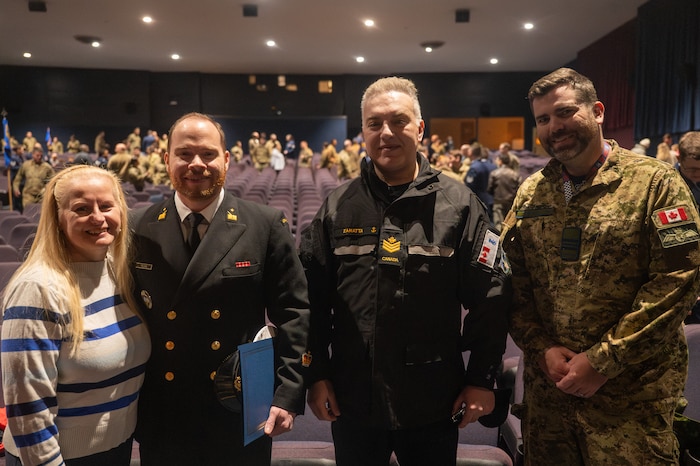
Stronger together: Canadians, Danes enhance interoperability through education
Graduates and their families celebrate at the graduation ceremony for the Noncommissioned Officer Academy on Joint Base Elmendorf-Richardson, Alaska, Feb. 10, 2026. Class 26-A included Canadian and Danish service members whose unique perspectives helped strengthen bonds among future allied leaders. (U.S. Air Force photo by Airman 1st Class Theodore Gowdy)
1 of 2
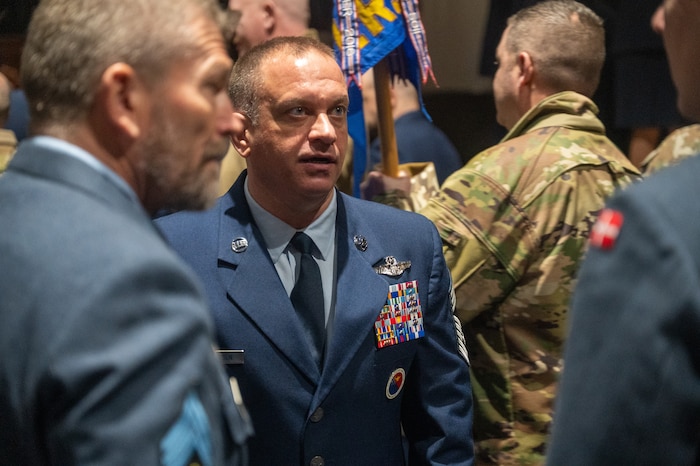
Stronger together: Canadians, Danes enhance interoperability through education
U.S. Air Force Chief Master Sgt. Adam Petersen, Elmendorf Professional Military Education Center commandant, speaks with representatives from the Royal Danish Air Force on Joint Base Elmendorf-Richardson, Alaska, Feb. 10, 2026. The Elmendorf PME Center hosted members of the Danish and Canadian armed forces for the Noncommissioned Officer Academy. (U.S. Air Force photo by Airman 1st Class Theodore Gowdy)
2 of 2
“A primary benefit is the cultivation of trust and interoperability with allied and partner forces, which is critical for the success of coalition operations,” explained Elmendorf PME Center Commandant, U.S. Air Force Chief Master Sgt. Adam Petersen. “Joint training allows the U.S. and its allies to establish a common understanding of operational procedures and doctrine, resulting in more seamless coordination when addressing mutual threats.”
The NCOA course spans 25 days and utilizes guided classroom discussion and experiential exercises to develop the students’ skills in team leadership, joint warfighting and strategic thinking.
According to U.S. Air Force Master Sgt. Max-Eddie Ibarrientos, Elmendorf PME Center Faculty Development section chief, this format allows the students to take full advantage of the diversity of perspectives and approaches present in the discussion. Class 26-A has the unique advantage of hearing from members of partner nations as well as other career fields.
“You can start to look at problems in only one way,” said Ibarrientos. “I had a colleague who used to say that ‘proximity changes perspective’ and that’s really stuck with me. Exposing your leaders to points of view from other career fields or other countries helps you to see issues and solutions from perspectives you might not have been able to see before.”
Royal Danish Air Force Master Sgt. Nanna Christiansen, an NCOA student, loves managing and working with people. She joined the RDAF from the private sector through a special program for individuals with relevant civilian experience and education. She was excited for the challenge of leadership, and the program has allowed her to progress through the ranks at an accelerated rate.
“I feel like I can bring my classmates the human perspective to leadership,” said Christiansen. “We have different kinds of contracts in Denmark. I’m able to leave whenever I want and so are most of the people I work with. We have to focus more on fostering personal relationships with employees, consider their work life balance and take their point of view into account.”
The discussion-based nature of the course allows the students to get to know one another on a more personal level, to form connections and even friendships. This is an intentional design feature of the course as these connections have real-world implications for the completion of future exercises and missions.
“The biggest thing you're going to take out of PME is networking,” said U.S. Air Force Tech. Sgt. Travis Porter, an Elmendorf PME Center instructor. “As leaders, we’re trying to get a job done. You never know when you’re going to need a medical laboratory scientist, or someone from finance, or a member of the Canadian or Danish armed forces. You should keep that in mind and come in ready to build relationships, and ready to hold on to those relationships.”
Royal Canadian Air Force Sgt. Lyle Multon, an NCOA student, has been in the RCAF for 30 years. As a young man he never saw the military as a future, but he says he has loved every minute since he joined. During his career, he has worked with the U.S. Air Force many times including in North Bay, Ontario, Canada; Hill Air Force Base, Utah; and Tinker Air Force Base, Oklahoma. In each location, Multon worked with the same U.S. Airman.
“What are the odds right?” said Multon. “I met that one USAF member on three different occasions doing three different jobs. I had to ask him if he was following me.”
Royal Canadian Navy Petty Officer 1st Class Jeremiah Young, an NCOA student, loves that NCOA allows him to interact with U.S. Air Force personnel. Though he’s been in the RCN for 21 years, he hasn’t had as much contact with U.S. forces as his Canadian colleague. The experience has taught him a lot about operating in a joint environment. During an experiential exercise, he said he started to see the solution to operational problems in a different light.
“We were able to relate to one another on a personal level, and I was able to associate a set of skills with an individual,” said Young. “I could put a face to a trade.”
This revelation highlights the importance of real, personal cooperation to the concept of interoperability. Despite the relative size differences between the U.S. forces, and the Danish and Canadian forces, these institutions are made up of people who work together to solve problems and complete any mission placed in their hands. By recognizing this human element of military strength and working closely with allies and partners during the training phase, this NCOA course may have more effectively prepared its students for the fight ahead.
“Having solid allies you can trust can really make or break your ability to be successful,” said U.S. Air Force Tech. Sgt. Sherita Ariola, Elmendorf PME Center Operations section chief. “We’re stronger together.”